
New This Week: Demand Map, Better Validation, and More Market Evidence
A Trend Seeker update covering the Demand Map, redesigned idea validator, Google Trends charts, app-review signals, sector briefs, and richer podcast evidence.
8 min read

Introduction
Since the last New This Week update on July 6, Trend Seeker has added a new way to explore demand, more evidence sources, deeper sector research, and a rebuilt startup idea validator.
The largest change is the Demand Map. It turns thousands of business ideas and their source signals into an interactive view of where related problems cluster. The rest of the work supports the same goal: help founders move from a broad market question to evidence they can inspect.
| Area | What changed | Best use |
|---|---|---|
| Demand Map | Interactive problem regions, demand lenses, search, and source filters | Finding adjacent opportunities and dense problem areas |
| Idea Validator | New experiment flow, clearer scoring, evidence tabs, trends, and competitor context | Testing one specific customer problem before building |
| Market evidence | Google Trends charts, public app reviews, X signals, and richer podcast transcripts | Comparing stated pain with search activity and product feedback |
| Sector research | 18 category pages with current snapshots, filtered maps, briefs, and featured ideas | Understanding one market before opening individual ideas |
The New Demand Map
The Demand Map groups semantically related ideas into problem regions. Large idea dots represent stronger supporting evidence. Smaller satellite dots reveal the source signals around a selected idea. Users can search the map, switch between total demand, fresh activity, and opportunity lenses, or narrow the view to sources such as Reddit, X, podcasts, job ads, Google Trends, and app reviews.
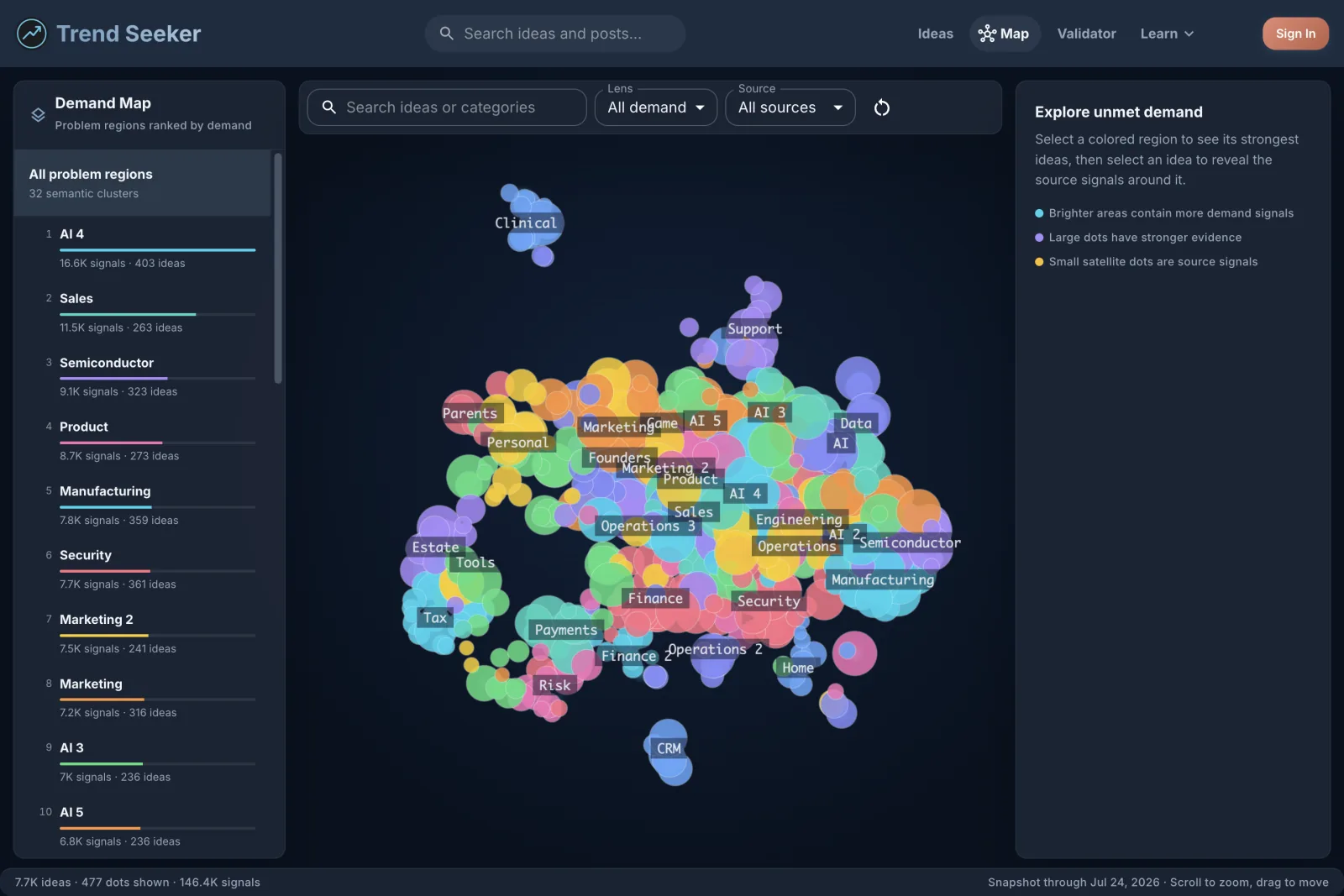
The map is useful when a list feels too narrow. A search for one idea can reveal nearby customer problems, overlapping categories, and signals that use different language for similar work. Selecting a region also provides a direct path back to its strongest ideas and underlying evidence.
Map density is a research priority, not proof of a market. A bright region can reflect a common problem, a broad topic, or several related needs. Open the idea and read the source mix before deciding what the cluster means.
More Ways to Measure Market Demand
Community posts remain useful, but they are only one view of a problem. Trend Seeker can now add search activity, public product feedback, and short-form discussions to the same evidence path used by Reddit, podcasts, and job ads.
| Source | What it can show | Important limit |
|---|---|---|
| Google Trends | Relative search interest, direction, recent median, and momentum for a related query | The index is relative, not search volume or revenue |
| Public app reviews | Complaints, missing features, migration pain, and repeated product gaps | One review can be an edge case rather than a market pattern |
| X | Fresh operator and customer language around emerging problems | Short posts need strict quality filtering and source context |
| Podcasts | Long-form explanations from founders, operators, and domain experts | A discussion is evidence of attention, not purchase intent |
Idea detail pages now chart available Google Trends history instead of showing only a query or summary number. Each chart includes the 0–100 interest index, a direction label, recent and baseline medians, momentum, and a link to inspect the query directly in Google Trends.
Public app reviews can appear as their own signal type. This makes it easier to separate product feedback from broad community discussion and compare review evidence with search interest, job-ad spending, or podcast commentary.
A Rebuilt Startup Idea Validator
The free startup idea validator now starts with a clearer experiment: describe the customer, their problem, and the proposed product. Trend Seeker matches that description by meaning against 147,919 market signals, then returns a score and the evidence behind it.
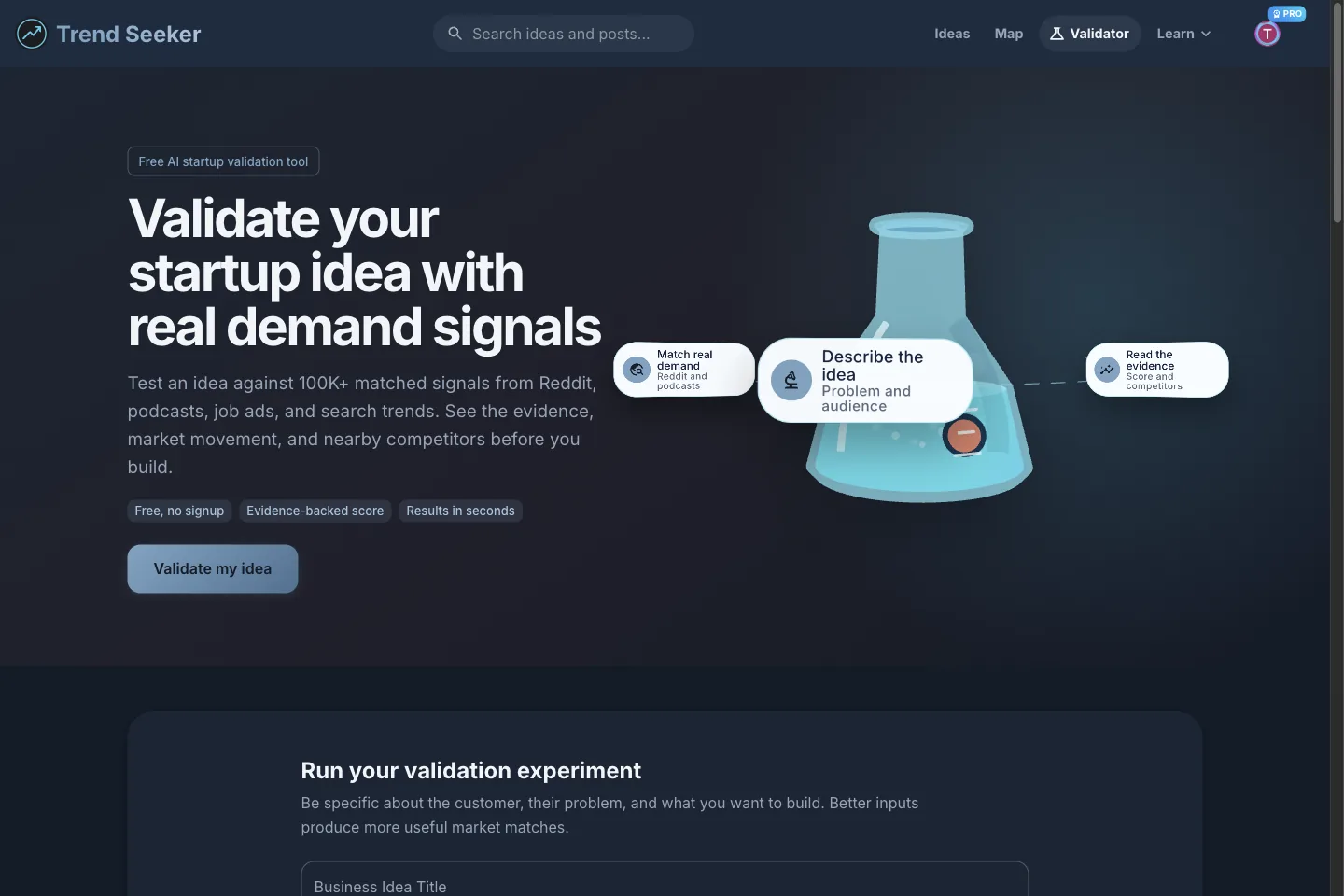
The result view separates market analysis from source evidence. It can show similar validated ideas, matching Reddit or podcast discussions, available search-trend queries, competitors, and an explanation of how the score was formed. Free checks work without signup.
The score is a research shortcut. It does not replace customer interviews, pricing tests, or a paid pilot. Its value is that users can open the matches and decide whether the underlying problem is close enough to the idea they described.
Evidence-Led Sector Pages
Trend Seeker now has 18 stable sector entry points, including SaaS, AI and machine learning, hardware, security, fintech, healthtech, developer tools, industrial automation, and other major categories.
These are more than filtered idea lists. Each page combines a current snapshot, a sector-specific Demand Map, an editorial brief, featured ideas, methodology, and links back to the live evidence. The page can explain the shape of a market before asking the reader to compare individual cards.
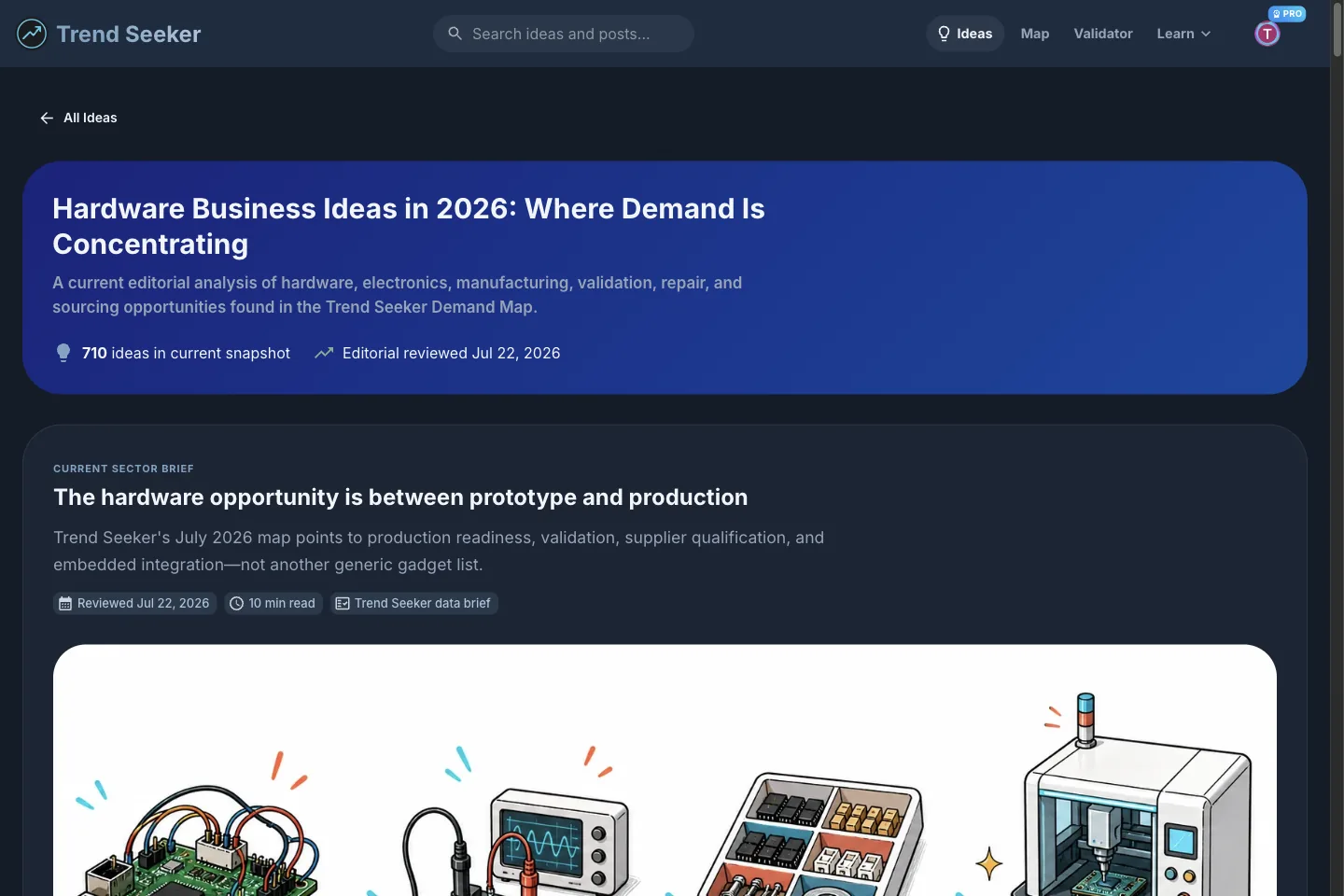
Sector briefs are dated and tied to a specific snapshot. This keeps the prose honest about when its counts and patterns were reviewed while the idea cards and maps continue to reflect the live database.
Richer Podcast Evidence
Podcast signals now carry more of the source conversation. When a full transcript is available, Trend Seeker groups it into speaker turns, shows timestamps, identifies known speakers, and highlights the passage that matched the business idea.
Episode release dates, feed names, audio links, and transcript links provide more context before a user treats one excerpt as evidence. The pipeline also looks further back across recent episodes while stricter quality gates keep weak transcript matches out of the idea feed.
Smaller Changes That Make Research Easier
- Abbreviation tooltips: ideas and articles can explain terms such as ARR?, CAC?, CRM?, MVP?, and TAM? without interrupting the paragraph.
- Category totals: sector pages show totals from the same snapshot used by their map and editorial analysis.
- Better navigation: returning from an article or idea restores more of the previous browsing position.
- More reliable mobile views: Demand Map labels and Google Trends charts now fit smaller screens more predictably.
- Faster first results: the map renders progressively, front-page trend coverage gets priority, and idea images refresh when generation finishes.
- Browser fixes: idea interactions were restored in Safari and card edges remain crisp when an idea uses its SVG fallback.
How to Use the New Research Flow
- Open the Demand Map and search for a problem, customer, or category.
- Compare total demand with fresh activity, then narrow the view by evidence source.
- Open a nearby idea and inspect its source mix, Google Trends chart, app reviews, or podcast passages.
- Read the relevant sector brief to understand the wider market and current snapshot.
- Describe a narrower product in the idea validator and compare its matches with the evidence you already read.
- Finish with customer interviews and a willingness-to-pay test. The product helps select and inspect evidence; it cannot make that decision for the customer.
Frequently Asked Questions
What has changed in Trend Seeker since July 6, 2026?
Trend Seeker added an interactive Demand Map, Google Trends charts, public app-review and X signals, evidence-led sector pages, a redesigned free idea validator, speaker-aware podcast transcripts, and clearer abbreviation tooltips across ideas and articles.
What is the Trend Seeker Demand Map?
The Demand Map is an interactive semantic view of business ideas and their supporting market signals. It groups related problems into regions, sizes ideas by evidence strength, and lets users compare total demand, fresh activity, opportunity scores, and individual source types.
How does the redesigned startup idea validator work?
The validator matches a specific startup idea by meaning against 147,919 market signals. It returns a demand score, related ideas, matching source evidence, and available Google Trends and competitor context. Free checks do not require signup.
Which market evidence sources can Trend Seeker analyze?
Trend Seeker can combine evidence from Reddit, X, podcasts, job ads, Google Trends, and public app reviews. Each source answers a different research question, and the original evidence remains available for inspection.
Do Trend Seeker scores prove that a business idea will work?
No. Scores and maps help prioritize research by showing repeated problems, activity, source mix, and nearby competition. Founders should still read the source evidence, interview likely customers, and test willingness to pay.
Where to Start
Start with the Demand Map if you are exploring a market, use the free idea validator when you have a specific concept, or open the latest weekly brief for a shorter view of the strongest recent signals.
Ready to find your next business idea?
Explore validated business ideas backed by real user demand.