
AI Evaluation Demand Signals: Where Teams Are Funding Quality Work
Trend Seeker filtered 6,863 valid AI evaluation signals through quality and demand gates. See what 1,427 strong records support and how to test an offer.
11 min read
Introduction
The strongest current evidence for an AI evaluation business is not the number of related ideas. It is the work that organizations are already paying employees to own.
Trend Seeker found 1,427 independent, high-quality demand signals in the current AI evaluation subset. Job ads contribute 1,254 of them. The repeated work is practical: build task sets, define graders, test agent outcomes, catch regressions, monitor production behavior, and decide whether a change is safe enough to ship.
That points to a focused first offer: a release-readiness sprint or managed evaluation gate for one real workflow. It does not yet prove demand for another broad evaluation platform.
What this article is for
The purpose of this article is to help a technical founder answer three questions:
- Is the evidence strong enough to spend time validating AI evaluation work?
- Where is budget visible, and what work is already being funded?
- What is the smallest offer that can test real willingness to pay?
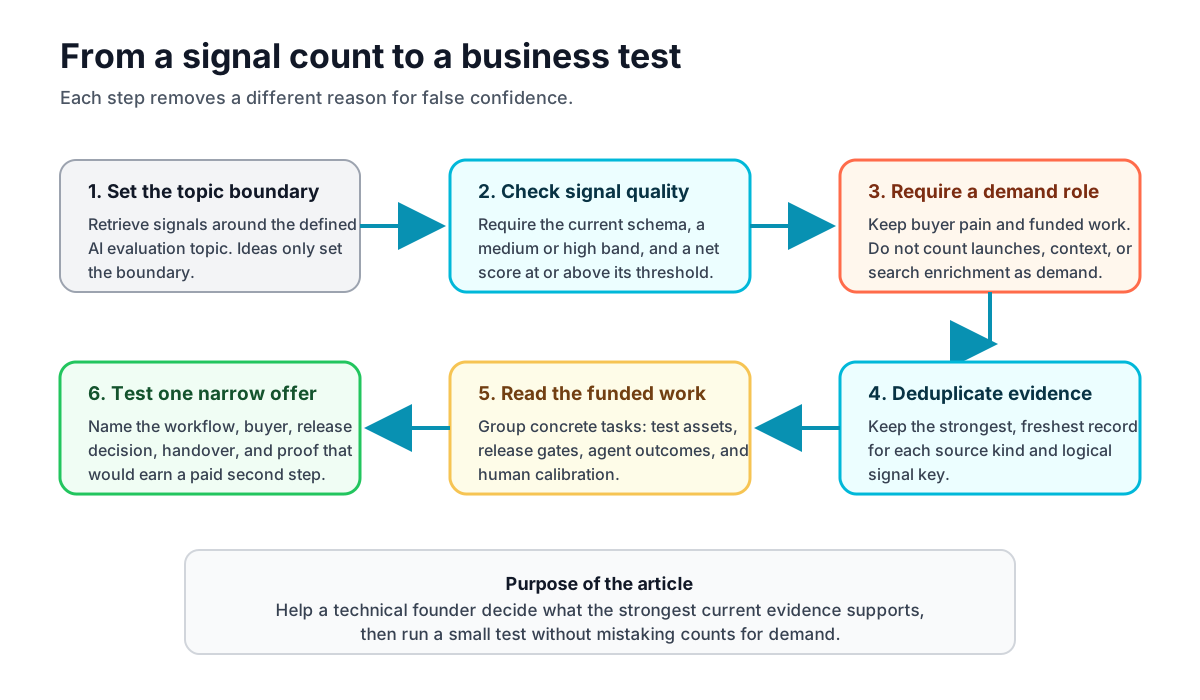
Each section has one job. The measurement section removes inflated counts. The source section shows where the budget signal comes from. The task-pattern section turns evidence into a possible service. The validation section turns that service into a test. The caveats explain what the data cannot answer.
| Section | How it helps the purpose | Decision it supports |
|---|---|---|
| Quality gates | Separates detailed records from direct demand evidence. | Whether the headline count is credible. |
| Source mix | Shows whether evidence comes from funded work, user pain, launches, or search interest. | Who to interview first. |
| Funded tasks | Groups the concrete responsibilities inside the strongest signals. | What the first offer should contain. |
| Thirty-day test | Moves from a data pattern to buyer conversations and a paid pilot. | Build, revise, or stop. |
| Limits | Keeps signals separate from buyers, companies, revenue, and market size. | How much confidence the evidence deserves. |
First, count signals that can support the claim
The Demand Map snapshot was generated on August 27, 2026 at 23:30 UTC and includes data through 23:15 UTC. The topic boundary uses all current regions whose names begin with AI Gaps. It selects 299 ideas with evaluation, eval, benchmark, quality, reliability, test, or assurance language in their titles.
Those ideas are retrieval containers. They define which part of the map to inspect. They are not the headline evidence in V2.
The resulting pool contains 6,863 valid independent logical signals after deduplication by source kind and logical signal key. Another 42 records present at snapshot generation had been invalidated by the August 28 claim check, so V2 excludes them. Trend Seeker then applies two separate checks:
- Quality check: the record must use the current v2 quality contract, have a medium or high band, and meet its source-specific weighted threshold.
- Demand-role check: the record must describe funded work or a qualifying problem, request, workaround, switching event, or willingness-to-pay cue. Launches, context, and search enrichment do not count as demand.
The difference matters. Of 4,466 valid independent records with a high quality band, only 1,427 also pass the demand-role check. A high-quality Product Hunt launch can describe supply clearly. A high-quality Google Trends record can describe relative search interest correctly. Neither one directly proves that a buyer has a problem.
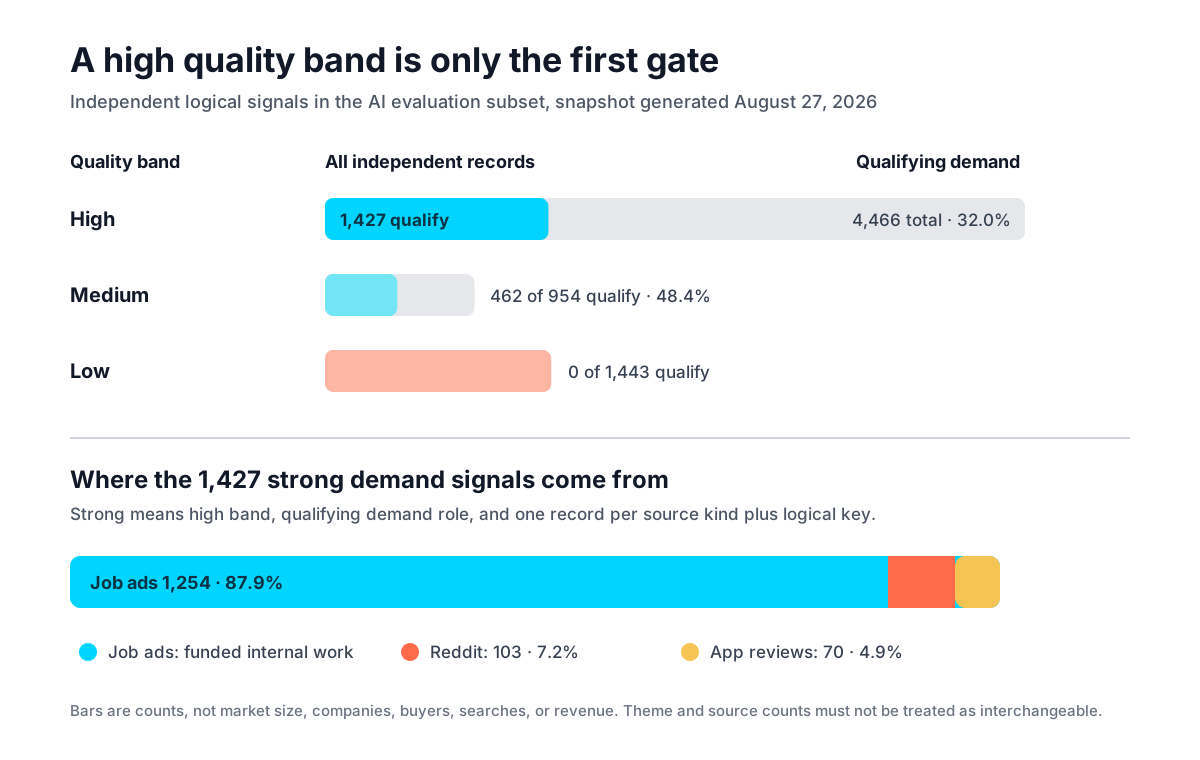
The broader qualifying-demand set contains 1,889 signals: 1,427 high and 462 medium. Of those, 221 were observed within seven days of the snapshot, 1,146 within 30 days, and 1,807 within 90 days. Freshness supports continued investigation. It does not turn a signal into a sale.
The strongest signal is funded internal ownership
Job ads account for 1,254 of the 1,427 strong demand signals, or 87.9%. Those records come from 1,056 distinct public job URLs?. A single posting can contribute several logical work sections, so 1,254 does not mean 1,254 openings, companies, or buyers.
The source concentration changes the commercial reading. This is strong evidence that organizations budget for AI evaluation work inside engineering, product, quality, and operations teams. It is weaker evidence that those organizations want to buy a standalone tool or outsource the whole function.
Representative postings in the snapshot make the work concrete:
- Canva's Evaluation Platform role describes ownership of an end-to-end evaluation lifecycle and test-like evaluations integrated with delivery work.
- A Microsoft Copilot evaluation role describes an offline platform that gates product quality before broad user impact.
- Ambience Healthcare's frontier AI role combines automated graders, regression tests, human evaluation, failure taxonomies, and offline-to-online validation.
These links are representative evidence, not a list of sales leads. Job pages can also close or change after the snapshot.
Reddit contributes 103 strong signals from 103 URLs. App reviews contribute 70 from 44 URLs. They add useful language about unreliable context, false-positive filters, poor agent behavior, incorrect generated media, and expensive failures. They do not outweigh the job-ad concentration.
What the strong signals say teams need done
A keyword review of the 1,427 strong-signal texts surfaces four overlapping task patterns. The counts must not be added together because one record can mention an agent, a release gate, and human review.
| Task pattern | Strong signals | What the work looks like | Practical offer |
|---|---|---|---|
| Agents and workflow outcomes | 588 | Test task success, tool use, trajectories, retrieval, latency, and cost. | Agent outcome suite for one workflow. |
| Release and production operations | 491 | Run regression checks, monitor behavior, investigate failures, and gate releases. | Managed release-readiness gate. |
| Human and domain assurance | 226 | Calibrate labels, rubrics, safety criteria, and specialist review. | Domain-specific grader calibration. |
| Evaluation assets and graders | 116 | Build golden datasets, test suites, evaluation pipelines, rubrics, and automated graders. | Evaluation foundation sprint. |
The pattern is consistent with current primary guidance. OpenAI's business evaluation primer recommends contextual evaluations built around a specific workflow and its desired outcomes. Its in-house data-agent case study uses curated questions, expected SQL?, returned data, and continuous regression checks rather than a single generic score.
Anthropic's guide to agent evaluations separates tasks, trials, graders, traces, outcomes, harnesses, and suites. It also recommends starting with 20 to 50 real tasks and combining deterministic, model-based, and human graders as the workflow requires.
NIST's Generative AI Profile says performance and assurance criteria should be demonstrated under conditions similar to deployment. That supports the same service boundary: define evidence that fits the buyer's real operating environment.
A practical offer supported by the signals
The best first test is not “we build AI eval infrastructure.” That still leaves the buyer to define the purpose, tasks, failure cost, and release threshold.
A narrower offer is easier to buy:
The handover should contain:
- 20 to 50 representative tasks from support cases, logs, product requirements, or expert examples;
- accepted outcomes, prohibited outcomes, cost limits, and escalation rules;
- deterministic checks where possible, model graders where useful, and human calibration where judgment matters;
- a baseline result, failure taxonomy, and examples that a product owner can inspect;
- a versioned suite plus a clear recommendation for the next release.
The likely buyer is the engineering manager, AI platform lead, product owner, or domain operator who already carries the release risk. The job-ad evidence suggests that an external offer competes with internal hiring. Position it as a fast baseline, specialist calibration, or overflow capacity—not as a replacement for ownership.
A 30-day validation plan
- Choose one workflow. Refund handling, clinical note review, code-agent changes, research output, and retrieval quality need different tasks and graders.
- Build a list of 20 relevant teams. Start with organizations publicly hiring for evaluation, reliability, AI quality, or agent infrastructure. Do not assume the open role means they will outsource.
- Run 10 discovery calls. Ask what changed before the last quality incident, how release approval works, what is still checked manually, and what evidence is missing.
- Offer a paid baseline. Scope one system, one decision owner, one task bank, and one written recommendation. Avoid an open-ended platform build.
- Set a stop rule. Continue only if at least two qualified teams will share real cases and one will pay for a scoped baseline or calibration step.
The live signals explorer can help track new evidence by source. The AI and Agents sector page is useful for adjacent workflows, but the validation decision should come from conversations and paid behavior, not another idea count. The startup validation guide covers interview and offer testing in more detail.
What the evidence does not prove
- It does not prove market size. Signal records, source URLs, job openings, companies, buyers, and revenue are different measures.
- It does not prove outsourcing demand. Job ads primarily show that teams fund the work internally.
- It does not prove every match is topically perfect. Signal quality measures the strength of the source record. Matching determines relevance to the topic. A strong Reddit post can still be only loosely related after semantic matching.
- It does not prove a platform gap. Product launches were excluded from demand, but they still show that evaluation tooling has active supply and competition.
- It does not make theme counts additive. The four task patterns overlap.
This is why a manual read still matters. Quality scores reduce noise. They do not replace judgment.
How V2 differs from the original article
The original AI evaluation business-opportunities article starts from ideas and uses their combined evidence to argue for workflow-specific production test suites. V2 asks a narrower question: after applying the new signal-quality and demand-role checks, what do the strongest independent records support?
| Version | Primary unit | Main purpose | Practical takeaway |
|---|---|---|---|
| V1 | Ideas plus attached logical signals | Map the opportunity pattern. | Workflow-specific test suites beat generic benchmarks. |
| V2 | Independent, quality-qualified demand signals | Judge the evidence and define a buyer test. | Funded internal evaluation work supports a narrow service test before a platform. |
The counts are not a trend comparison. The snapshots, region layout, and measurement rules differ. Keep both versions for editorial comparison, but use V2 when the question is signal strength.
Methodology
This analysis uses Demand Map version a6bcfdcb-12b1-4012-919d-7fd6d42f395a, generated August 27, 2026 at 23:30:15 UTC with data through 23:15:00 UTC. It selects ideas in every current region whose name starts with AI Gaps, then applies the title expression evaluat|(^| )eval(s|ops)?( |$)|benchmark|quality|reliability|test|assurance. The 299 selected ideas define the evidence boundary.
Signals are joined to the current raw-signal quality record. Records invalidated by the August 28 claim check are removed from the quality-band pool. A qualifying demand signal must be valid, use quality schema v2, have a medium or high band, meet or exceed its weighted net threshold, and play a demand role under the current source rules. Job ads qualify only for supported work sections. Reddit launches are excluded. App reviews qualify only for problem, feature-request, workaround, switching, or willingness-to-pay subtypes. Accepted podcasts can qualify. Product Hunt, Google Trends, Hacker News, and AlternativeTo records do not play a demand role in this measurement.
Independent counts keep one strongest and freshest record per source kind plus logical signal key. “Strong” narrows that set to high-band qualifying demand signals. Theme counts use case-insensitive keyword expressions over titles and raw text. They overlap and are descriptive, not a trained taxonomy. Source URLs and representative records were checked on August 28, 2026.
Sources and further reading
Ready to find your next business idea?
Explore validated business ideas backed by real user demand.