
AI Evaluation Business Opportunities: Why Production Test Suites Beat Generic Benchmarks
Trend Seeker found 194 AI evaluation ideas backed by 4,244 distinct signals. The practical wedge is a workflow-specific test suite tied to release decisions.
14 min read
Introduction
The clearest AI evaluation business opportunity is not another generic benchmark dashboard. It is a workflow-specific test suite tied to a real release decision. The buyer needs to know whether an agent completes the task, whether a retrieval system uses the right evidence, whether a prompt change causes a regression, and when a human must review the result.
Trend Seeker's Demand Map snapshot generated August 26, 2026 contains 194 relevant ideas connected to 4,244 distinct logical signals. The same subset has 5,271 idea-signal matches and 3,168 distinct public source URLs?. The pattern points toward evaluation operations: define accepted outcomes, maintain representative cases, combine graders, investigate failures, and decide whether a change can ship.
What the AI evaluation subset measures
This analysis starts with region 30, AI Gaps, then selects ideas whose titles contain evaluation, eval, benchmark, quality, reliability, test, or assurance language. The filter is reproducible, but it is editorial. It captures product, service, and internal-operations shapes rather than a clean market category.
| Measure | August 26 snapshot | Definition |
|---|---|---|
| Relevant ideas | 194 | Distinct ideas in AI Gaps matching the stated title filter. |
| Distinct logical signals | 4,244 | Evidence deduplicated by source kind and logical signal key across the subset. |
| Idea-signal matches | 5,271 | Connections between ideas and signals. One logical signal can support several ideas. |
| Distinct source URLs | 3,168 | Unique public URLs among the deduplicated records that include a URL. |
| Fresh logical signals | 257 in 7 days 1,111 in 30 days 3,546 in 90 days | Most recently observed in exact windows ending at snapshot generation. |
The source mix matters because each source answers a different question. Job ads show work that organizations fund internally. Podcasts and Reddit expose practitioner language and failure modes. App reviews show user-facing quality problems. Product Hunt usually shows supply or competition. Google Trends shows relative search interest, not volume.
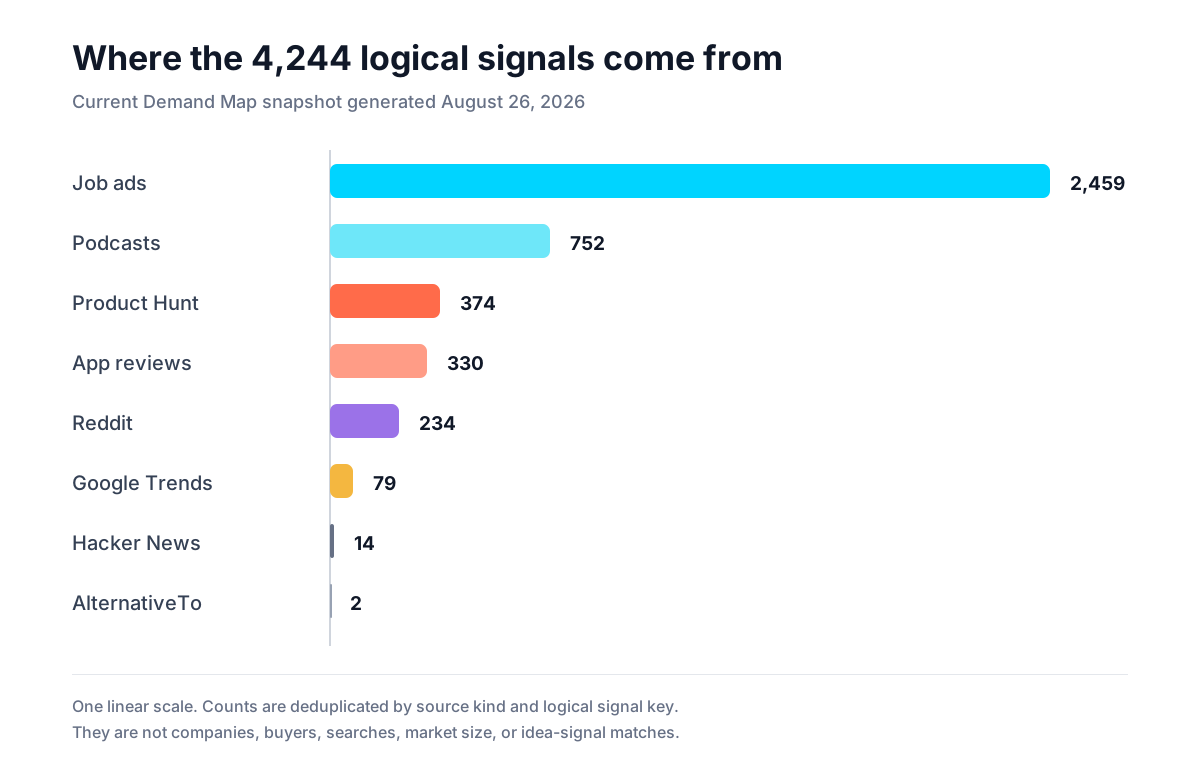
Job ads contribute 2,459 signals, or 57.9% of the subset. That makes funded internal work the strongest input, but not the only one. Product Hunt contributes 374 records, enough to treat horizontal evaluation tooling as a competitive field rather than an empty category.
The non-obvious finding: the product is a maintained decision system
A public benchmark answers a useful but limited question: how systems compare on a fixed task set and harness. A production team has a different question. It needs to know whether its configured system can perform one job with the available context, tools, policies, latency, cost, and human-review path.
OpenAI's current primer on contextual evaluations for businesses makes this distinction directly. Frontier evaluations do not capture every nuance of a specific workflow, so teams build evaluations around their own products and internal processes. OpenAI's GDPval work similarly moves from exam-style benchmarks toward realistic occupational tasks.
NIST's Generative AI Profile says performance or assurance criteria should be demonstrated under conditions similar to the deployment setting. It also recommends field testing, documented measurement, and sharing pre-deployment results with people who hold release authority. Those are operating responsibilities, not just features in a dashboard. See the NIST publication page and its deployment-measurement profile.
The diagram below shows the service boundary. The evaluator does not merely produce a score. It maintains the task bank, grading logic, threshold, evidence, and feedback loop that make a ship-or-hold decision defensible.
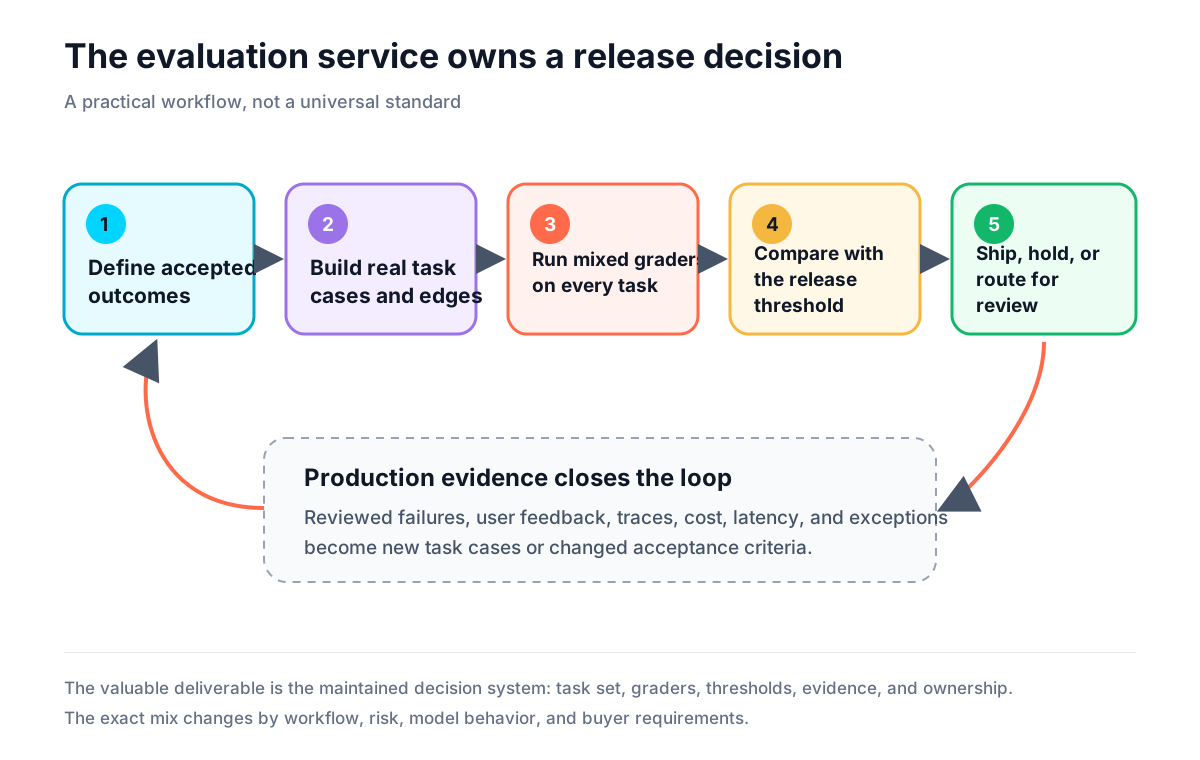
Anthropic's guide to evaluating AI agents describes the same practical complexity. Agent tests may need several trials, code-based checks, model graders, human judgment, complete traces, and verification of the final environment state. No single layer catches every failure. That creates room for specialists who know both the evaluation machinery and the buyer's domain.
Three AI evaluation opportunity patterns
The theme filters overlap and must not be added together. An agent reliability studio can appear in all three when it benchmarks models, tests regressions, and includes human or safety review.
1. Workflow evaluation and private benchmarking
This theme contains 116 ideas, 2,457 distinct logical signals, and 2,902 idea-signal matches. It includes evaluation operations, private benchmarks, model selection, task-suite design, and unified evaluation pipelines.
The strongest examples are managed AI evaluation ops for production model teams with 251 matches, an AI evaluation operations studio with 228, and a unified LLM evaluation pipeline with 189.
A practical first offer is a two-week evaluation baseline. Choose one workflow and two plausible model or system configurations. Collect representative tasks from logs, support cases, or expert examples. Define accepted outcomes and cost limits. Run the comparison, review the failures with the domain owner, and deliver a model decision plus the reusable test set.
2. Regression testing and release assurance
This theme contains 89 ideas, 2,307 distinct logical signals, and 2,824 idea-signal matches. It covers reliability, behavior regression, quality checks, test coverage, and release assurance.
Examples include an agent reliability evaluation studio with 184 matches, an AI coding quality-control console with 155, and managed behavior regression testing for consumer AI products with 70.
This work begins after a team already has a useful system. Every prompt, model, retrieval, tool, policy, or workflow change can improve one behavior and damage another. A managed release gate runs a stable suite before each change, investigates failures, records approved exceptions, and updates cases when production finds a new edge.
OpenAI's account of its in-house data agent offers a concrete example. Its team compares both generated SQL? and returned data against expected results, then uses evaluations as ongoing regression tests. That is closer to software quality operations than a one-time model leaderboard.
3. Human and domain assurance
This theme contains 68 ideas, 1,669 distinct logical signals, and 2,087 idea-signal matches. It covers safety, guardrails, bias, integrity, regulated use, clinical workflows, and human review.
The AI companion conversation quality audit has 158 matches. A production AI reliability studio for clinical LLM workflows has 62. Both need more than a generic correctness score. They need scenario design, explicit rubrics, specialist judgment, escalation rules, and evidence about where automated graders disagree with people.
OpenAI's published GDPval grading material uses expert preference as its standard and treats an LLM? judge as a rough estimate. Its HealthBench uses realistic conversations and physician-written rubric criteria. These examples do not prove an outsourcing market. They show why domain judgment can be part of the evaluation product.
Five offers a specialist can test
| Offer | Buyer trigger | Required handover | Important limit |
|---|---|---|---|
| Evaluation baseline sprint | A team cannot choose between models or configurations | Task set, rubrics, results, failures, and recommendation | A benchmark does not predict every production outcome |
| Managed regression gate | Prompt, model, or tool changes repeatedly break behavior | Versioned suite, thresholds, release report, and failure log | The client keeps release authority |
| Agent trajectory testing | An agent uses tools across several steps | Tasks, environment, traces, outcome checks, and retry analysis | A final-answer score alone is not enough |
| RAG? evaluation calibration | Answers look fluent but grounding is unreliable | Retrieval cases, citation checks, human labels, and grader calibration | One combined score can hide retrieval failures |
| Independent release assurance | A high-trust workflow needs evidence before launch | Scope, test record, unresolved risks, and ship-or-hold recommendation | Not certification, legal advice, or a guarantee of safety |
The narrowest offer is usually the best first test. “We build eval infrastructure” leaves the buyer to define the decision. “We tell the support-product owner whether the new agent can handle refunds without breaking escalation policy” defines the workflow, owner, and outcome.
How this differs from general AI implementation
Trend Seeker's existing analysis of AI implementation services covers the full path from workflow discovery through integration, governance, adoption, and production ownership. Evaluation operations are one layer inside that path.
This article is narrower. The deliverable is a maintained decision system for quality. An implementation team may build the application. The evaluation specialist defines how its behavior is measured, which failures block release, how graders are calibrated, and how production evidence changes the suite.
The boundary matters for positioning. A small specialist does not need to replace the buyer's model platform, observability stack, or development team. It can fit into the existing delivery process and own the evidence required for one decision.
Why this matters now
The timing case is directional, not a search-volume claim. The rendered worldwide Google Trends helper was checked on August 27, 2026 for LLM evaluation. In the five-year rising-query panel, LLM benchmark, LLM evaluation framework, and RAG evaluation were marked Breakout. In the three-month top-query panel, LLM evaluation framework had a relative index of 100, RAG evaluation 72, and LLM evaluation metrics 64. Google Trends scales results from 0 to 100 within each panel. It is not public search volume.
Trend Seeker's own GSC? data is much weaker. The current window contained no exact evaluation-query row. In the previous window, AI behavior evaluation, AI team benchmarking, and LLM evaluation pipeline each produced one impression. That is not enough to claim a first-party search foothold.
Current search results are crowded with framework comparisons, observability platforms, and service pages. A “best LLM evaluation tools” article would compete on a changing vendor list. Trend Seeker can answer a different question with proprietary evidence: which evaluation jobs recur, how they divide into service patterns, and what a founder can sell before building another horizontal platform.
The durable driver is system change. Models, prompts, retrieval, tools, policies, and user behavior all move. A useful evaluation suite becomes operational infrastructure because every release and production failure can change the evidence behind the next decision.
What the evidence does not prove
The 4,244 logical signals are not 4,244 buyers, companies, jobs, searches, or incidents. There are 5,271 idea-signal matches because one signal can connect to several ideas. The 3,168 source URLs are another measure. None of these figures is revenue, contract value, or total addressable market.
Job ads are 57.9% of the evidence. They show that organizations fund evaluation-related work internally. They do not show which tasks procurement will outsource or whether a small provider can access the required systems and data. Read the job-ad signal guide before treating hiring evidence as customer demand.
The 374 Product Hunt records mainly describe existing supply. They strengthen the case that teams build evaluation products, but they also warn against a generic dashboard. A founder still needs a buyer, proprietary task data, a repeatable decision, and a reason the existing stack cannot handle it.
Evaluation itself has limits. A test set can miss real failures, leak into development, encode the wrong objective, or become stale. Model-based graders can disagree with people or be sensitive to framing. A passing suite does not prove a system is safe. OpenAI's current guidance on trustworthy third-party evaluations stresses that the tested system, harness, resource budget, elicitation method, and validity checks all shape what a result can support.
A 30-day validation plan
- Choose one workflow and release owner. Start with a person who already decides whether a change can ship.
- Collect 30 to 50 real tasks. Use approved examples from logs, support cases, expert demonstrations, or recent failures. Remove sensitive data and document selection bias.
- Define accepted outcomes before grading. Separate hard checks, rubric judgments, cost or latency limits, and cases that require human review.
- Sell a fixed baseline sprint. Compare the current system with one proposed change. Deliver the suite, results, failure clusters, unresolved risks, and a release recommendation.
- Offer maintenance only if the decision repeats. Version the cases, run them before changes, add production failures, and calibrate automated graders against people.
Compare the opportunity with live AI and machine learning, Developer Tools, and Data and Analytics business ideas. The evidence-score guide explains why different source types should not be treated as interchangeable. The startup validation guide covers the next step: finding out whether one buyer will pay.
Methodology
This analysis uses Demand Map version f8104a20-eb0f-47af-94b0-bd6ed86b1f33, generated at 23:30 UTC on August 26, 2026, with source data through 23:27 UTC that day. The snapshot was less than one day old when the claims were checked.
We selected region 30, AI Gaps, then matched evaluation, eval, benchmark, quality, reliability, test, or assurance language in idea titles. A distinct logical signal is deduplicated by source kind and logical signal key across the selected ideas. An idea-signal match is one connection between an idea and a signal. A distinct source URL is one public evidence location among deduplicated records that include a URL. Freshness windows end at snapshot generation. These measurements are related but not interchangeable.
The three themes use overlapping filters. Workflow evaluation and private benchmarking matches evaluation, eval, benchmark, or model-selection language and contains 116 ideas, 2,457 logical signals, and 2,902 matches. Regression and release assurance matches reliability, regression, test, quality, or assurance language and contains 89 ideas, 2,307 signals, and 2,824 matches. Human and domain assurance matches safety, guardrail, bias, integrity, regulated, clinical, or human language across titles, taglines, problem summaries, and categories; it contains 68 ideas, 1,669 signals, and 2,087 matches. The theme counts must not be summed.
We reviewed the highest-signal ideas, representative public records, current Trend Seeker articles and category pages, current search results, the latest GSC export, rendered worldwide Google Trends results for five-year and three-month windows, competing products and services, and the primary sources below. GSC impressions and Google Trends indices were used only as search-intent context. They were not counted as Demand Map signals or public search volume.
Sources and further reading
- OpenAI: How evals drive the next chapter in AI for businesses
- OpenAI: Measuring performance on real-world tasks
- Anthropic: Demystifying evals for AI agents
- NIST: Generative AI Profile
- OpenAI: Inside the in-house data agent
- Hacker News: custom benchmark launch discussion
- Product Hunt: AgentX production evaluation launch
- Trend Seeker: current AI Gaps Demand Map
Ready to find your next business idea?
Explore validated business ideas backed by real user demand.