
AI Search Business Ideas: Why Measurement Comes Before GEO? Optimization
Trend Seeker found 36 AI search ideas linked to 751 non-launch signals and 407 Product Hunt competition records. The best opening is measurement for a specific buyer.
13 min read
Introduction
The clearest AI search business opportunity is not another promise to “rank in ChatGPT.” It is reliable measurement of where a brand appears, which sources are cited, and how those observations change across repeated tests.
Trend Seeker's Demand Map snapshot generated on July 28, 2026 contains 36 relevant AI search ideas connected to 751 non-launch signals. Another 407 Product Hunt launch records are tracked separately as product-supply and competition evidence. Once those measurements are separated, buyer-specific services and trackers look more attractive than another generic audit dashboard.
What the Demand Map says now
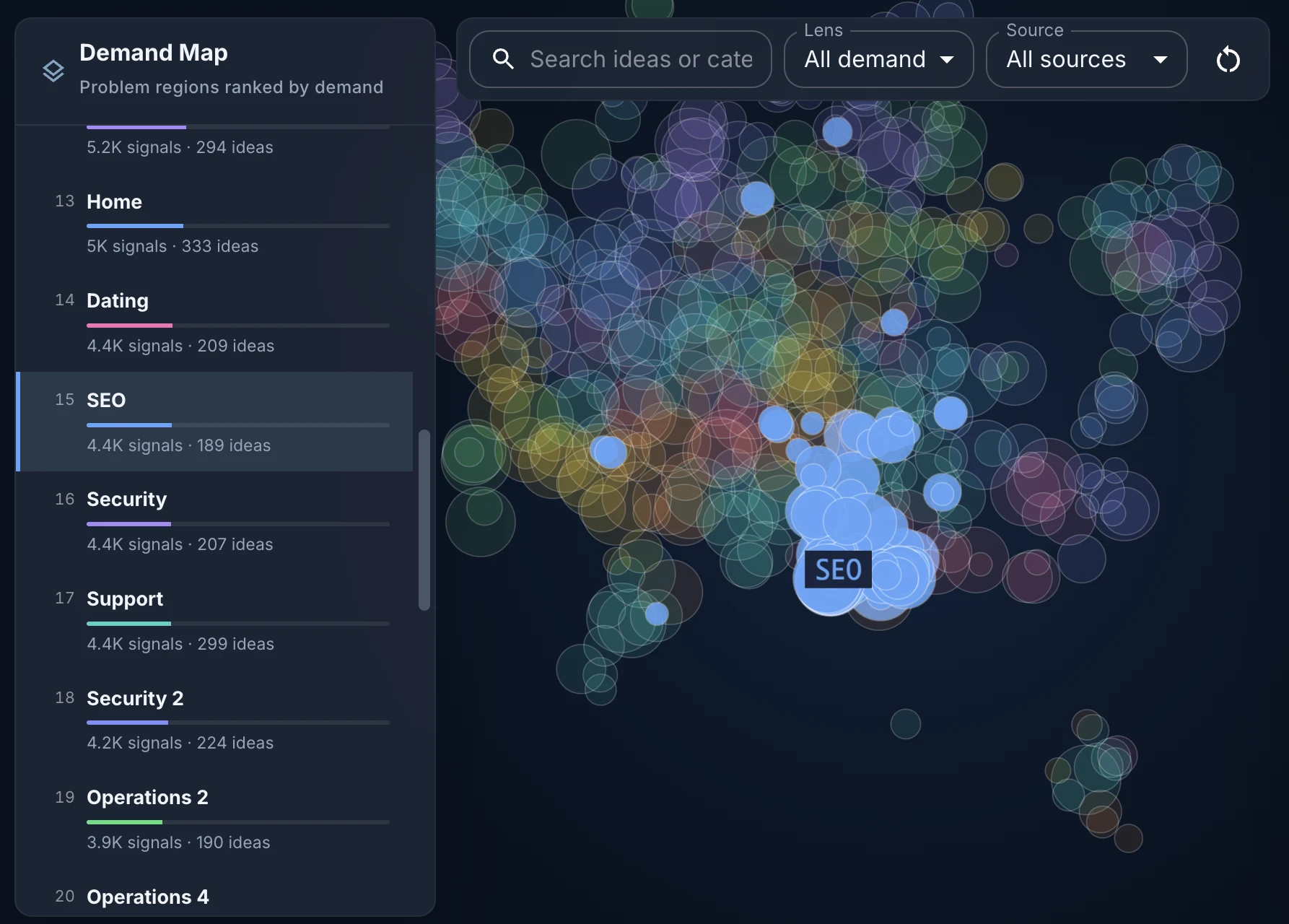
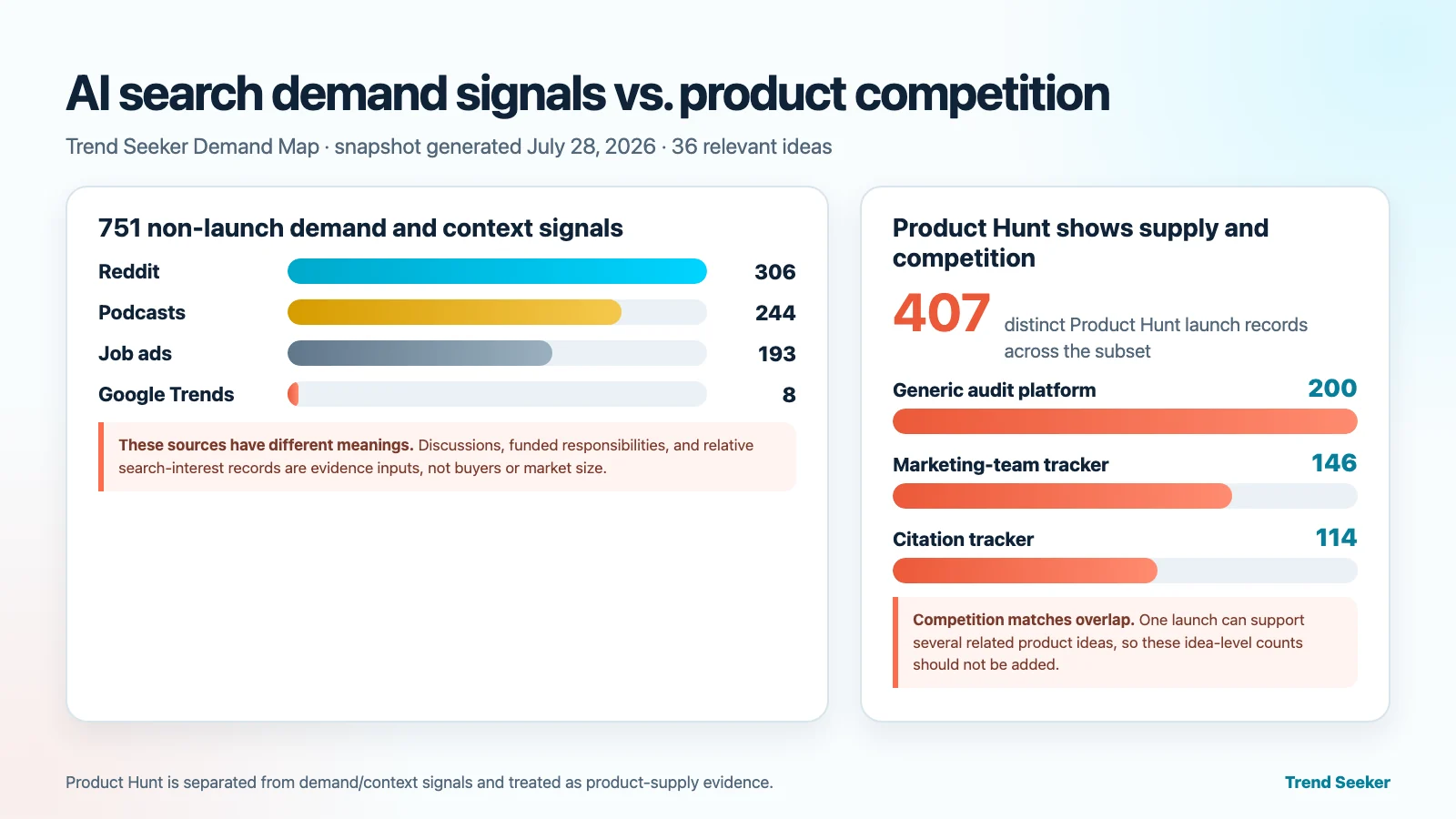
Separating market signals from launches changes the opportunity ranking. The 36-idea subset contains 751 distinct non-launch signals: 306 from Reddit, 244 from podcasts, 193 from job ads, and 8 Google Trends records. Product Hunt contributes another 407 distinct launch records, but those are treated as evidence of product supply and competition rather than folded into demand. The Demand Map view below locates the SEO? cluster within Trend Seeker's broader problem landscape; it provides product context, while the filtered counts come from the snapshot analysis that follows.
The strongest non-launch support belongs to an AI search visibility SEO retainer for B2B SaaS and EdTech with 128 signals. The marketing-team visibility tracker has 108, the citation tracker 83, and the generic audit platform 82. Yet the generic platform overlaps with 200 Product Hunt competition matches, compared with only 3 for the vertical retainer. The practical opening is a focused measurement product or service for one buyer, not a category-wide dashboard.
| Measure | July 28 snapshot | Definition |
|---|---|---|
| Relevant ideas | 36 | Ideas in SEO Gaps matching the stated AI-search filter. |
| Non-launch signals | 751 | Reddit, podcast, job-ad, and Trends evidence deduplicated by source kind and logical signal key. |
| Product Hunt competition | 407 | Distinct launch records, reported separately as product-supply evidence. |
| Non-launch idea-signal matches | 843 | Connections between ideas and non-launch signals. One signal can support several related ideas. |
| Non-launch source URLs? | 574 | Unique public evidence URLs among non-launch records that include a URL. |
| Fresh non-launch signals | 32 in 7 days 252 in 30 days | Most recently observed within exact windows ending at the snapshot time. |
The comparison chart below makes the section's central distinction visible: conversations, funded responsibilities, and search-interest records form the non-launch evidence mix, while Product Hunt launches sit on the competition side. That separation matters because combining them would make the most crowded generic products appear stronger than more focused opportunities.
Why measurement is still the first product
These ideas begin with observation because generated answers can vary by prompt wording, follow-up context, system, location, time, and model behavior. The product opportunity is to run comparable samples, preserve answers and cited sources, and report change without presenting one response as a stable rank.
Microsoft's AI Performance report in Bing Webmaster Tools illustrates the distinction. It reports citations, cited pages, grounding queries, and changes over time, while explicitly saying those measures do not indicate ranking, authority, or placement within an answer. That is a useful standard for independent tools too.
Three overlapping opportunity themes
The themes below overlap, so their counts must not be added together. They describe three layers of the same market.
1. Visibility measurement and citation audits
Twenty-eight of the 36 ideas match measurement terms such as audit, visibility, citation, monitoring, tracking, attribution, or entity analysis. This is the strongest entry point because it can produce a bounded deliverable before anyone debates optimization tactics.
A useful audit should show which prompts represent buyer research, which brands and sources recur, what changed between samples, and which claims remain unsupported. Products such as Appsrow AEO Analyzer and AI VISIBILITY validate competition, not a winning feature set.
2. Optimization services built on a baseline
Thirty-one ideas match service, retainer, optimization, content, readiness, refresh, or fix terms. The strongest service-shaped opportunity is an AI search visibility SEO retainer for B2B SaaS and EdTech with 128 non-launch signals and only 3 Product Hunt competition matches.
A defensible engagement starts with crawlability, indexing, source quality, entity clarity, useful content, business data, and a measurement plan. Google's generative AI search guide says AEO? and GEO are still SEO from Google's perspective and rejects shortcuts such as special AI markup, content “chunking,” or inauthentic mentions.
3. Vertical and workflow-specific products
Twenty-six ideas include a buyer or vertical cue such as B2B? SaaS?, local businesses, ecommerce, agencies, professional services, travel, healthcare, or finance. A vertical focus can turn a generic tracker into a product with a meaningful prompt library and clear actions.
A local product can combine answer sampling with profiles, reviews, and location questions. A B2B product can track comparisons, integrations, and competitor prompts. A professional-services audit can focus on expertise, cited claims, and recommendation questions. The vertical determines which sources are credible and which actions the buyer can take.
Five AI search businesses a small team can test
| Offer | First buyer | Evidence delivered | Important limit |
|---|---|---|---|
| Fixed-scope AI visibility audit | Marketing lead preparing an AI search plan | Prompt set, repeated samples, mention and citation baseline, source gaps | A sample is not a universal rank |
| Citation tracker for SEO teams | Agency or in-house search team | Cited URLs, grounding topics, competitors, changes over time | Supported surfaces expose different evidence |
| AI search entity audit | Brand with inconsistent web information | Entity facts, conflicting sources, profile gaps, correction backlog | Consistency does not guarantee inclusion |
| Vertical prompt library and benchmark | B2B SaaS, local, ecommerce, or services operator | Buyer-stage questions, category baseline, source patterns, quarterly update | The library must reflect real buyer language |
| Measurement-led optimization retainer | Team with a baseline but no operating cadence | Prioritized tests, content and technical changes, repeat measurements | Do not attribute every change to the retainer |
What a credible measurement product must do
The workflow diagram below translates the measurement argument into a product sequence: define buyer questions, repeat the samples, preserve an evidence ledger, and only then recommend tests. Each step exists to prevent a single generated answer from becoming an unexplained visibility score.
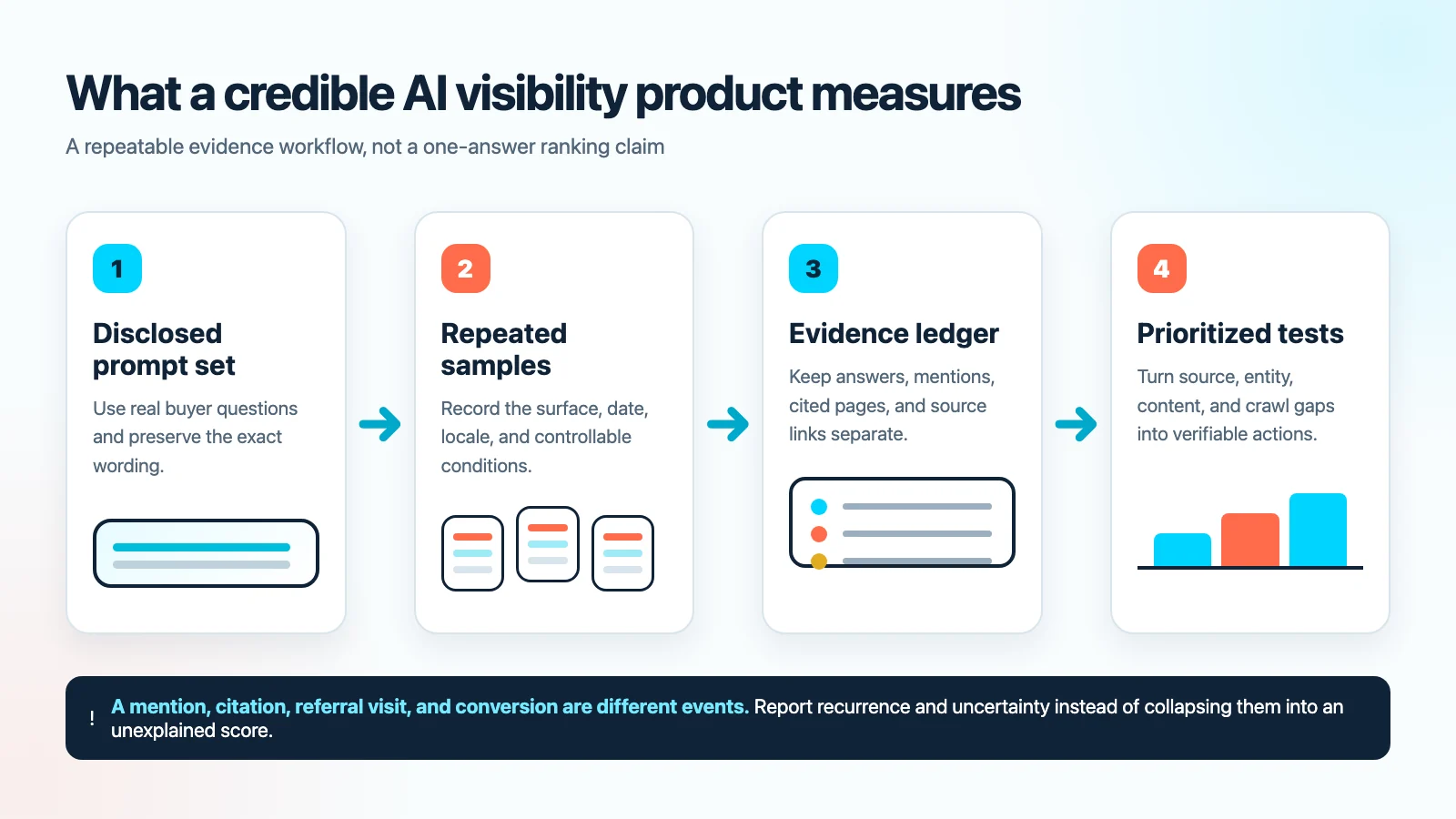
Buyers should be able to inspect the prompt set, sample conditions, answers, citations, recurrence, and missing data behind any score. The product becomes useful when it turns those observations into crawl, source, entity, content, or conversion tests that can be verified independently.
Why this matters now
AI answers are becoming a measurable publishing surface. ChatGPT search provides answers with links to web sources. Bing now exposes publisher citation reporting. Google now documents a generative AI performance report in Search Console and continues to include AI search performance in its own reporting.
The 30-day timeline below tests whether Trend Seeker's supporting evidence is merely historical. It is not: 252 non-launch signals were most recently observed during the window, although the uneven daily pattern and July 7 spike also show why founders should look for sustained themes rather than treating one busy day as growth.
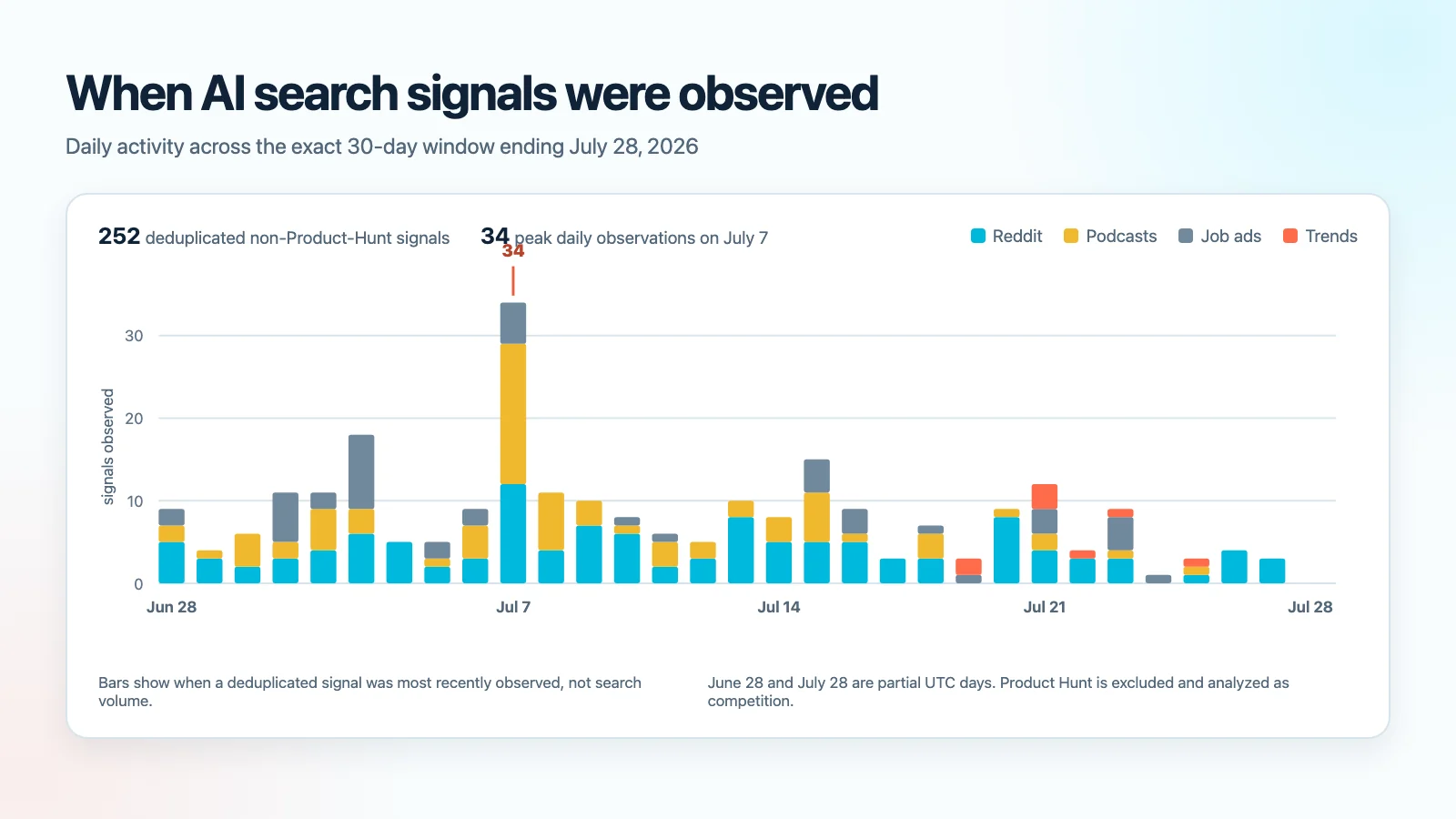
At the same time, the category is crowded and the language is unstable. “AEO,” “GEO,” “LLM? optimization,” and “AI search visibility” often describe overlapping work. A generic definition page or another opaque score will be easy to copy.
The durable opportunity is narrower: help one type of buyer ask better questions, collect reproducible observations, understand the cited-source landscape, and decide which improvements are worth testing.
What the evidence does not prove
The 751 non-launch signals are not 751 customers, companies, searches, or job openings. There are 843 non-launch idea-signal matches because one logical signal can support several related ideas. The 574 non-launch source URLs are a separate measurement. None of these numbers is public search volume.
The 407 Product Hunt records are competition evidence, not demand signals. Launch activity shows that builders are entering the category and may indicate crowding. Reddit posts and podcast discussions can repeat vendor narratives. Job ads show funded responsibilities, not necessarily a preference for external software or services.
The rendered Google Trends helper was run for AI search visibility, answer engine optimization, and generative engine optimization across worldwide five-year and three-month windows. It returned no usable rendered values, so this article reports no Trends index. Google Trends would be a relative 0–100 index, not search volume or a Demand Map count.
Trend Seeker's current GSC? window also contains a small amount of relevant query activity, including 19 impressions and no clicks for ai brand geo tracking. That is an internal search-performance observation, not evidence of total market demand.
A 30-day validation plan
- Choose one buyer and decision. Start with a marketing team deciding what to fix, an agency proving work, or a local operator checking recommendation questions.
- Build the prompt set with buyers. Collect actual research and comparison questions instead of inventing a large synthetic keyword list.
- Run a manual baseline. Repeat the same questions, preserve citations, and document where outputs vary before building a dashboard.
- Sell an audit. Deliver the baseline, source gaps, prioritized tests, limitations, and a date for the next sample.
- Automate the repeated step. Build software only around collection, comparison, evidence storage, or reporting that several paying audits need.
Compare these opportunities with the live Marketing and Sales business ideas and Data and Analytics business ideas categories. Then use the startup validation guide to test whether a buyer will pay for the baseline before you build a tracker.
Methodology
This analysis uses Demand Map version df6d08f9-9b96-4887-97cc-1eeac30ccfcf, generated at 04:27 UTC on July 28, 2026, with source data through 03:36 UTC that day. The snapshot was current when the claims were checked.
We selected the SEO Gaps region, then matched a case-insensitive term group across each idea's title, categories, macro categories, and problem summary: AI search, answer engine, generative engine, LLM near visibility or citation, citation near tracking or monitoring, GEO tracking, and brand near GEO.
A distinct logical signal is deduplicated by source kind and logical signal key across the subset. An idea-signal match is one connection between an idea and a logical signal. A source URL is one public evidence location. Product Hunt records were removed from the non-launch totals and reported separately as competition. These measures are related but not interchangeable.
The three themes use separate transparent term groups over the same idea fields. The measurement group matched 28 ideas, optimization and services 31, and vertical cues 26. They overlap and should not be summed. We reviewed the highest-signal ideas and representative evidence, current GSC queries, the rendered Google Trends helper, current search results, existing Trend Seeker pages, and primary platform guidance. GSC impressions and Google Trends records were not used as demand counts.
Sources and further reading
Ready to find your next business idea?
Explore validated business ideas backed by real user demand.