
AI Security Business Ideas: The Service Gaps Around Agents
Trend Seeker found 160 AI-security ideas backed by 4,313 distinct signals. The strongest service gaps are code hardening, agent identity, and runtime assurance.
14 min read
Introduction
The best-supported AI security business ideas are not one more prompt-injection scanner. Trend Seeker's current Demand Map points to three broader service gaps: hardening AI-generated code, establishing identity and authorization for agents, and testing or monitoring agent behavior at runtime.
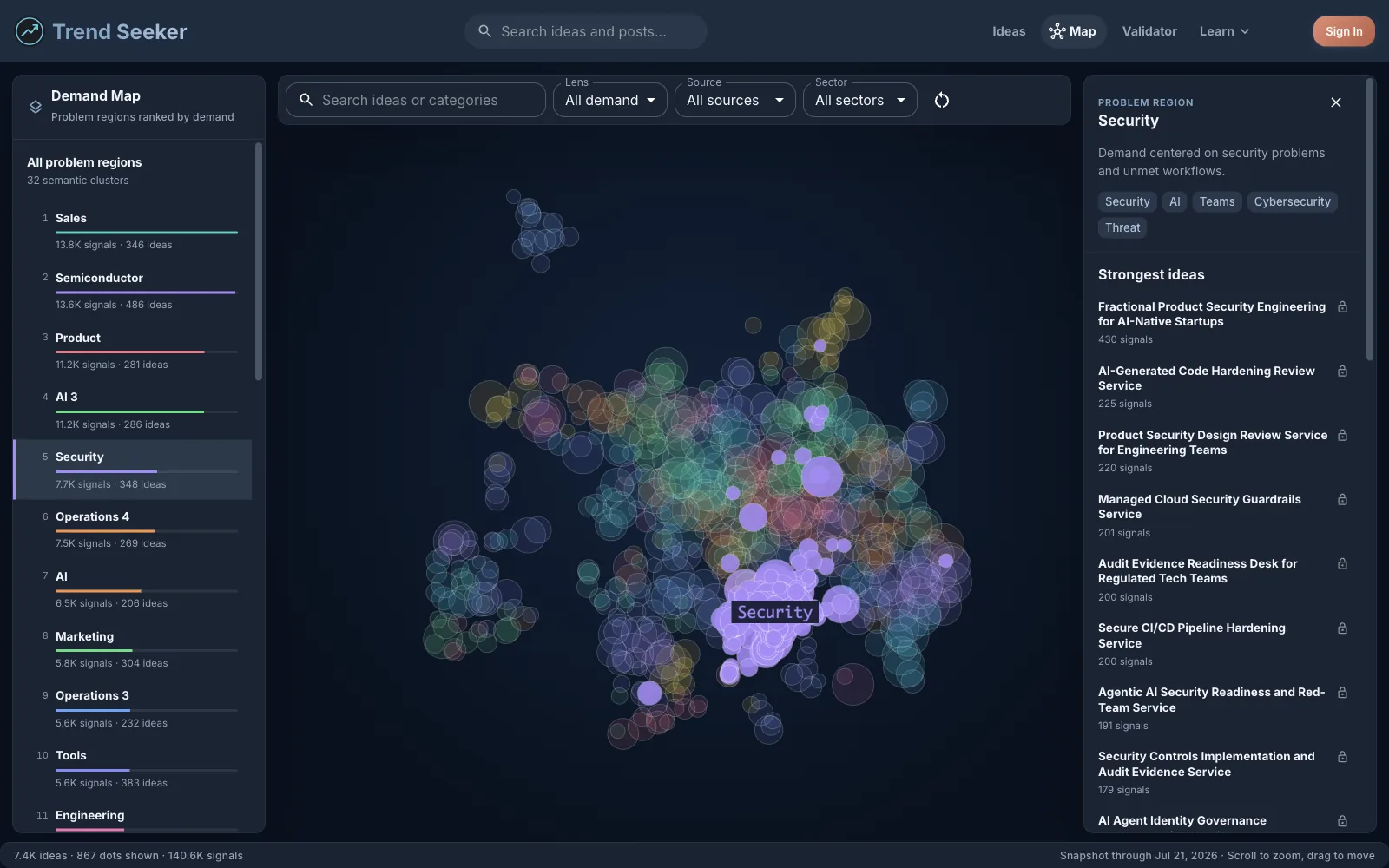
In the snapshot generated on July 21, 2026, Trend Seeker found 160 AI-security ideas connected to 4,313 distinct logical signals. The strongest individual ideas include fractional product-security engineering for AI-native startups, AI-generated code hardening, agentic red-team readiness, agent identity governance, control implementation, and runtime-control readiness.
What the Demand Map says now
The full Security Gaps region contains 348 ideas and 7,663 distinct logical signals. This article uses a narrower subset: ideas whose title, categories, or problem summary contains AI, artificial intelligence, agentic, AI agent, LLM?, large language model, machine learning, or ML? language.
The filter produced 160 relevant ideas. It can include adjacent controls and product-security work when the idea summary makes an AI connection. That breadth is useful for finding service wedges, but it is not a taxonomy of the entire AI-security market.
| Measure | July 21 snapshot | Definition |
|---|---|---|
| Relevant ideas | 160 | Security-region ideas matching the stated AI-language filter. |
| Distinct logical signals | 4,313 | Evidence deduplicated within each source by logical signal key. |
| Idea-signal matches | 5,479 | Connections between ideas and signals. One logical signal can support several ideas. |
| Distinct source URLs? | 3,097 | Unique public URLs among records that include a URL. |
| Fresh logical signals | 251 in 7 days 3,762 in 30 days | Observed relative to the snapshot generation time. |
Job ads contribute 3,534 of the subset's 4,313 distinct signals. Podcasts contribute 499, Product Hunt 173, and Reddit 107. The mix is less job-ad-heavy than the AI implementation subset, but hiring evidence still dominates. It shows funded security work, not 3,534 companies looking for a vendor.
The non-obvious finding: security work splits across three boundaries
AI security coverage often collapses several problems into one list. The Demand Map separates them. Code written with AI still enters a software supply chain. Agents need identities and scoped authority before they call tools. Deployed systems need testing, monitoring, containment, and evidence after release.
Those boundaries create different buyers and deliverables. An engineering leader can buy a code-hardening review. An identity or cloud-security team can buy an agent-access inventory and authorization design. A product-security or risk team can buy a threat model, red-team test, and runtime evidence package.
NIST's February 2026 software and AI agent identity concept paper is a useful external marker. It focuses on how identification, authentication, and authorization apply when agents acquire context and take actions. The older identity problem has a new actor and a new delegation chain.
Three AI security service patterns
The theme counts below overlap and should not be summed. A secure deployment may need all three.
1. AI-generated code and application security
This theme contains 50 ideas connected to 1,718 distinct signals. The leading example is an AI-generated code hardening review service with 225 distinct signals. Related ideas cover AI developer-tool reviews, application security, secure CI/CD, and product-security support for AI-native teams.
The service wedge is not "review all AI code." Pick one release boundary. A useful engagement inventories AI-assisted changes, maps sensitive data and trust boundaries, verifies dependency and secret handling, reviews high-risk code paths, adds targeted tests, and leaves a remediation backlog with owners.
This works because the deliverable is familiar even when the code origin changes. The buyer needs evidence that a release met an agreed bar. A founder can begin with manual review and automation already used by the client's engineering team, then build specialized detection only where repeated failures justify it.
2. Agent identity, governance, and compliance
This is the largest theme: 102 ideas and 3,199 distinct signals. It includes agent identity, authorization, AI controls, governance, audit evidence, customer assurance, and compliance operations.
The AI agent identity governance implementation service is a concrete starting point. Inventory every agent in one environment. Record its owner, purpose, tools, data access, credentials, delegation path, approval requirements, logs, and revocation process. Then redesign one high-risk access path using least privilege and short-lived authority where the environment supports it.
Do not sell guaranteed compliance. NIST's AI Risk Management Framework is voluntary guidance, and its generative-AI profile covers governance, pre-deployment testing, incident disclosure, and other risk-management work. A small vendor can help implement and document controls, but the organization remains responsible for its risk decisions and legal obligations.
3. Red-team, runtime, and threat assurance
This theme contains 87 ideas and 2,524 distinct signals. It includes agentic red teaming, runtime controls, threat detection, testing, scanners, incident response, and post-deployment assurance.
An agentic AI security readiness and red-team service has 191 distinct signals. An AI runtime-control readiness service has 152. The practical distinction matters: a red team tries to make the workflow fail before or during release; runtime assurance checks whether controls, logs, and response paths still work after deployment.
A focused engagement can test one agent's prompt and input boundaries, tool misuse, destructive actions, data exposure, privilege escalation, unsafe delegation, and recovery behavior. The handover should include reproducible cases, severity, control coverage, residual risk, and a retest plan—not a theatrical list of prompts.
Five services a small team can test
| Offer | Buyer trigger | Evidence delivered | Likely buyer |
|---|---|---|---|
| AI code hardening review | AI-assisted release approaching production | Reviewed boundary, findings, tests, and remediation backlog | Engineering or product security |
| Agent identity inventory | Agents use shared credentials or unclear owners | Inventory, ownership map, privilege gaps, and revocation plan | IAM or cloud security |
| Agentic threat-model sprint | A workflow gains tools or sensitive data | Trust boundaries, abuse cases, controls, and test plan | Product security or platform engineering |
| Red-team and retest | Release gate or customer security review | Reproducible findings, severity, fixes, and retest evidence | CISO, risk, or product owner |
| Runtime-control readiness | A deployed agent can take material action | Logging coverage, control tests, containment runbook, and incident exercise | Security operations or AI platform |
Why this matters now
The external search landscape is moving quickly. Current results include guides for agent identity, governance, zero trust, and runtime protection as well as vendor products. A generic "what is agentic AI security" page would be hard to differentiate. Trend Seeker's useful contribution is to connect those categories to current work signals and service-shaped founder wedges.
Rendered Google Trends data reinforces the distinction between a broad category and a narrow phrase. AI agent security returned usable worldwide five-year and three-month views on July 22, 2026, with agentic AI among its rising related queries. The exact phrase machine identity for AI agents returned no usable rendered data in either window. AI-generated code security returned usable five-year data but no usable three-month view.
Those results are directional. Google Trends reports relative interest from 0 to 100, not search volume. It is not comparable to Trend Seeker signals, GSC? impressions, job ads, or idea-signal matches. The lack of data for a narrow phrase does not invalidate a service if direct buyers describe the problem in different language.
What the evidence does not prove
The 4,313 distinct logical signals are not 4,313 buyers, jobs, companies, or searches. There are 5,479 idea-signal matches because one logical signal can support several related ideas. The 3,097 distinct source URLs are another measurement. None is a market-size estimate.
Job ads contribute about 82% of the subset. They show funded work, but a company hiring a security engineer may specifically want internal ownership. Security also carries trust, access, insurance, and procurement requirements that can make an outside engagement hard for a new firm to win.
The service must be narrower than the risk universe. Start where the founder already has access and credibility: one codebase, identity stack, deployment platform, regulated workflow, or red-team method. Review the job-ad signal guide and the startup validation guide before treating signal strength as purchase intent.
A 30-day validation plan
- Choose one boundary. Code, identity, pre-release testing, or runtime response is enough for the first offer.
- Interview ten owners. Ask about the last blocked release, customer questionnaire, access exception, failed control, or agent incident.
- Request a real artifact. A repository, agent manifest, access inventory, threat model, evaluation set, or runbook exposes more than a general survey.
- Sell a fixed review. Define systems in scope, test methods, evidence handling, deliverables, exclusions, and a retest date.
- Productize repeated evidence. Build software only when several buyers need the same inventory, test, policy check, or report.
Compare these opportunities with the live Security business ideas and AI business ideas categories. The guide to starting a business with AI covers the broader path from evidence to a paid first test.
Methodology
This analysis uses Demand Map version 8f1d345a-a3dc-424d-9062-83c1fb84fe2b, generated at 04:23 UTC on July 21, 2026, with source data through 03:34 UTC that day. The snapshot was one day old when the claims were checked.
We selected region 22, Security Gaps, then matched AI-language terms across each idea's title, categories, and problem summary. The terms cover AI, artificial intelligence, agentic, AI agent, LLM, large language model, machine learning, and ML. A distinct logical signal is deduplicated within its source by logical signal key. An idea-signal match is one connection between an idea and a signal. A source URL is one public evidence location.
The three themes use transparent term groups across the same fields. They overlap, so their counts should not be summed. We reviewed the highest-signal ideas and representative public evidence in each theme. We also checked current GSC queries, rendered Google Trends results, current search results, existing Trend Seeker pages, and the primary sources below. GSC impressions and Google Trends indices were not used as demand counts.
Sources and further reading
Ready to find your next business idea?
Explore validated business ideas backed by real user demand.
This week Trend Seeker found
+2,098ideas
and
+70,184signals
%22%20%2F%3E%0A%20%20%20%20%20%20%0A%20%20%20%20%20%20%3C!--%20Sun%20--%3E%0A%20%20%20%20%20%20%3Ccircle%20cx%3D%22248%22%20cy%3D%22108%22%20r%3D%2223%22%20fill%3D%22hsl(40%2C%2060%25%2C%2075%25)%22%20opacity%3D%220.85%22%20%2F%3E%0A%20%20%20%20%20%20%0A%20%20%20%20%20%20%3C!--%20Background%20Hill%201%20--%3E%0A%20%20%20%20%20%20%3Cpath%20d%3D%22M%200%2096%20Q%20160%2092%20400%2076%20L%20400%20160%20L%200%20160%20Z%22%20fill%3D%22hsl(200%2C%2020%25%2C%2060%25)%22%20%2F%3E%0A%20%20%20%20%20%20%0A%20%20%20%20%20%20%3C!--%20Midground%20Hill%202%20--%3E%0A%20%20%20%20%20%20%3Cpath%20d%3D%22M%200%20112%20Q%20260%2061%20400%2085%20L%20400%20160%20L%200%20160%20Z%22%20fill%3D%22hsl(215%2C%2015%25%2C%2045%25)%22%20%2F%3E%0A%20%20%20%20%20%20%0A%20%20%20%20%20%20%3C!--%20Foreground%20Hill%203%20--%3E%0A%20%20%20%20%20%20%3Cpath%20d%3D%22M%200%20128%20Q%20120%20107%20400%20110%20L%20400%20160%20L%200%20160%20Z%22%20fill%3D%22hsl(225%2C%2020%25%2C%2030%25)%22%20%2F%3E%0A%20%20%20%20%20%20%0A%20%20%20%20%20%20%3C!--%20Technical%20grid%20overlay%20removed%20for%20a%20cleaner%20organic%20look%20--%3E%0A%20%20%20%20%3C%2Fsvg%3E)
%22%20%2F%3E%0A%20%20%20%20%20%20%0A%20%20%20%20%20%20%3C!--%20Sun%20--%3E%0A%20%20%20%20%20%20%3Ccircle%20cx%3D%22194%22%20cy%3D%22104%22%20r%3D%2259%22%20fill%3D%22hsl(10%2C%2050%25%2C%2055%25)%22%20opacity%3D%220.85%22%20%2F%3E%0A%20%20%20%20%20%20%0A%20%20%20%20%20%20%3C!--%20Background%20Hill%201%20--%3E%0A%20%20%20%20%20%20%3Cpath%20d%3D%22M%200%2096%20Q%20160%2078%20400%2089%20L%20400%20160%20L%200%20160%20Z%22%20fill%3D%22hsl(25%2C%2030%25%2C%2068%25)%22%20%2F%3E%0A%20%20%20%20%20%20%0A%20%20%20%20%20%20%3C!--%20Midground%20Hill%202%20--%3E%0A%20%20%20%20%20%20%3Cpath%20d%3D%22M%200%20112%20Q%20260%20122%20400%20128%20L%20400%20160%20L%200%20160%20Z%22%20fill%3D%22hsl(20%2C%2035%25%2C%2052%25)%22%20%2F%3E%0A%20%20%20%20%20%20%0A%20%20%20%20%20%20%3C!--%20Foreground%20Hill%203%20--%3E%0A%20%20%20%20%20%20%3Cpath%20d%3D%22M%200%20128%20Q%20120%20131%20400%20137%20L%20400%20160%20L%200%20160%20Z%22%20fill%3D%22hsl(15%2C%2025%25%2C%2035%25)%22%20%2F%3E%0A%20%20%20%20%20%20%0A%20%20%20%20%20%20%3C!--%20Technical%20grid%20overlay%20removed%20for%20a%20cleaner%20organic%20look%20--%3E%0A%20%20%20%20%3C%2Fsvg%3E)
%22%20%2F%3E%0A%20%20%20%20%20%20%0A%20%20%20%20%20%20%3C!--%20Sun%20--%3E%0A%20%20%20%20%20%20%3Ccircle%20cx%3D%22139%22%20cy%3D%2299%22%20r%3D%2259%22%20fill%3D%22hsl(10%2C%2050%25%2C%2055%25)%22%20opacity%3D%220.85%22%20%2F%3E%0A%20%20%20%20%20%20%0A%20%20%20%20%20%20%3C!--%20Background%20Hill%201%20--%3E%0A%20%20%20%20%20%20%3Cpath%20d%3D%22M%200%2096%20Q%20160%20103%20400%2089%20L%20400%20160%20L%200%20160%20Z%22%20fill%3D%22hsl(25%2C%2030%25%2C%2068%25)%22%20%2F%3E%0A%20%20%20%20%20%20%0A%20%20%20%20%20%20%3C!--%20Midground%20Hill%202%20--%3E%0A%20%20%20%20%20%20%3Cpath%20d%3D%22M%200%20112%20Q%20260%20102%20400%20108%20L%20400%20160%20L%200%20160%20Z%22%20fill%3D%22hsl(20%2C%2035%25%2C%2052%25)%22%20%2F%3E%0A%20%20%20%20%20%20%0A%20%20%20%20%20%20%3C!--%20Foreground%20Hill%203%20--%3E%0A%20%20%20%20%20%20%3Cpath%20d%3D%22M%200%20128%20Q%20120%20116%20400%20135%20L%20400%20160%20L%200%20160%20Z%22%20fill%3D%22hsl(15%2C%2025%25%2C%2035%25)%22%20%2F%3E%0A%20%20%20%20%20%20%0A%20%20%20%20%20%20%3C!--%20Technical%20grid%20overlay%20removed%20for%20a%20cleaner%20organic%20look%20--%3E%0A%20%20%20%20%3C%2Fsvg%3E)