
Software Demand Report, October 2026: What 19,883 Records Can Tell Us
A reproducible snapshot of 1,535 SaaS?-tagged ideas: 19,883 distinct records, with hiring, reviews, discussions, product launches, and search interest counted separately.
8 min read
Introduction
A large pile of software signals is useful only after asking what each source can prove. Our October 9, 2026 snapshot contains 1,535 non-hidden SaaS-tagged ideas connected to 19,883 distinct logical evidence records. We separate 17,541 potential demand records from 2,219 Product Hunt launch records and 123 relative search-interest records.
The most useful result is the distinction between work, friction, and supply. Hiring descriptions can reveal work organizations fund. Reviews and discussions can reveal problems or workarounds. Launches reveal products already offered. Those questions belong in the same research process, but their counts should not become a single claim about customers.
Download source totals, the 19,883-record metadata table, and the checksum manifest. These contain metadata, not copied source bodies or personal contact lists.
The evidence mix behind this software catalog
The chart shows record counts from our selected catalog. Hiring descriptions and app reviews are the largest sources here. That reflects collection coverage as well as matching and quality decisions; it does not mean those sources represent the largest markets or the strongest purchase intent.
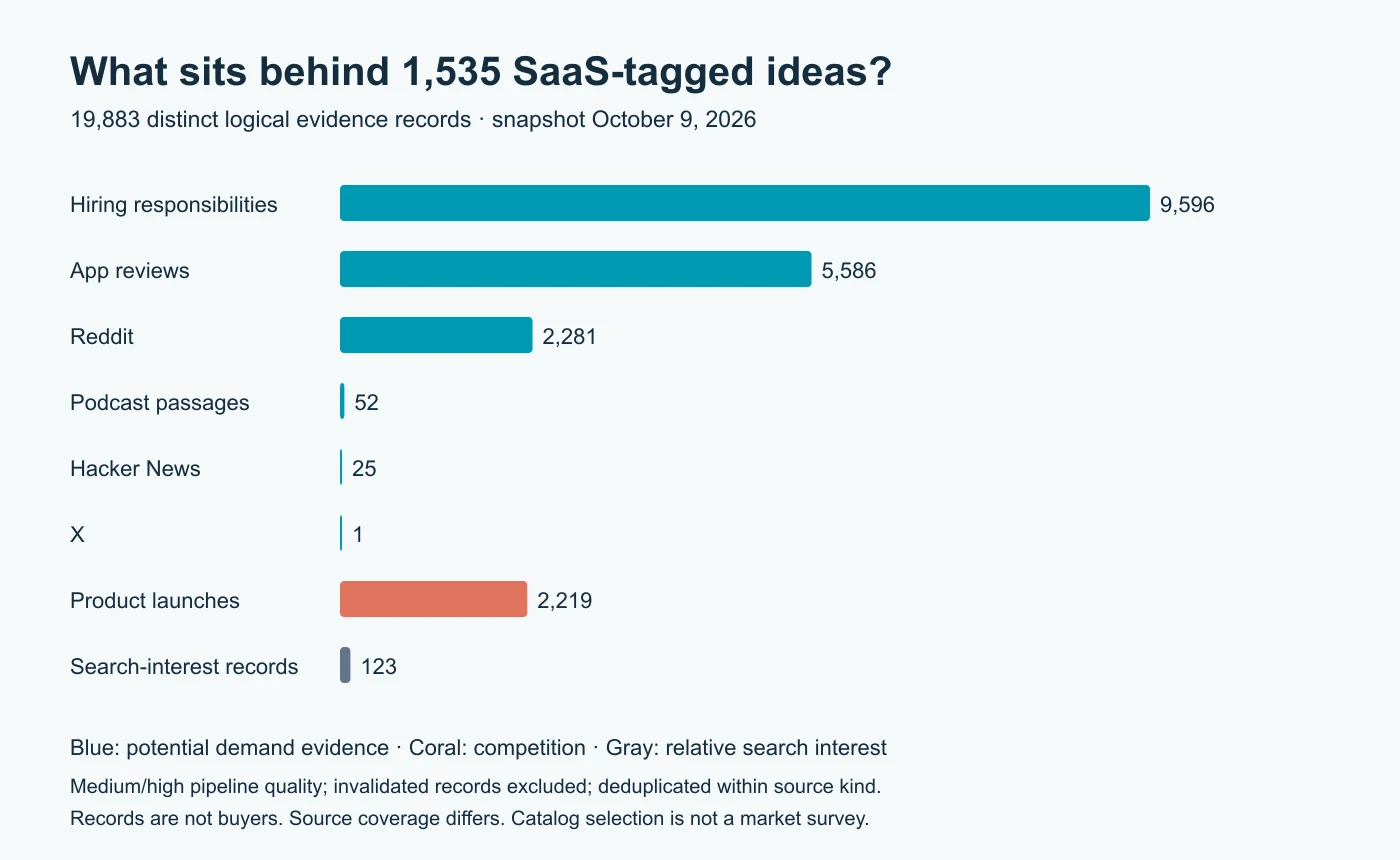
| Source | Distinct records | Question it can help answer |
|---|---|---|
| Hiring responsibilities | 9,596 | What work are organizations assigning to paid roles? |
| App reviews | 5,586 | What do users report about existing products? |
| 2,281 | What questions, frustrations, workarounds, or product proposals appear in discussions? | |
| Podcast passages | 52 | How do speakers describe a workflow or business problem? |
| Hacker News | 25 | Which technical questions or product examples deserve further investigation? |
| X | 1 | What does this particular public post show? |
| Product Hunt launches | 2,219 | What products have been supplied? |
| Search-interest records | 123 | What relative query-interest observations are attached to these ideas? |
Three mistakes the counts do not justify
1. Treating hiring as a software purchase order
A job description can show that a responsibility has organizational value. It does not establish that the employer will outsource it or buy a small SaaS. The next question is whether a narrow tool removes a repeated part of the workflow without introducing more coordination, permission, or support work.
2. Treating a launch as independent buyer demand
A builder describing their own product may also describe a real problem. Their launch still needs to be distinguished from an independent user's complaint. Use product examples to map alternatives, then look for repeated buyer behavior and an identifiable decision-maker.
3. Adding related idea counts together
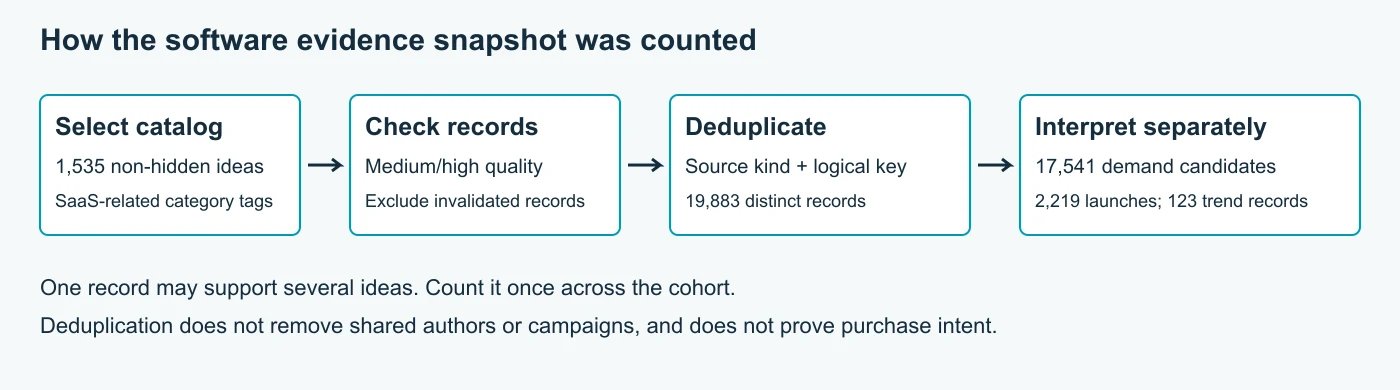
One discussion or job description can support several related ideas. Adding the displayed counts would count that evidence repeatedly. Our snapshot counts a logical record once across the whole cohort, using its source kind and logical key. This still does not deduplicate people or coordinated cross-posts.
The diagram below shows where that deduplication occurs. Selection, quality filtering, deduplication, and interpretation are separate steps; changing one can change the output without any change in the underlying market.
Four workflows to investigate with reachable buyers
These examples turn the distinction into specific research questions. They are selected illustrations from the catalog, not a statistical ranking of underserved markets.
- Community discovery: founders ask how to find relevant communities. Test a reviewed shortlist before building an automated engagement system.
- Backup verification: a backup tools discussion is a starting point for interviews. Ask an administrator to show a failed restore or a missing report, rather than assuming another dashboard is needed.
- First customer acquisition: founders compare how they obtained paying customers. A useful first product might record one channel experiment and its outcomes.
- Account deletion: an engineering discussion about handling personal data after deletion suggests a workflow question. A first tool could inventory data and record completion against a human-approved policy.
Our 37 micro SaaS ideas guide adds a buyer, bounded first version, existing workflow, source example, limitation, and first test for each idea. The validation tools comparison and Idea Validator can help organize the research, but interviews and paid experiments remain separate evidence.
Methodology
The database snapshot was captured at 2026-10-09 08:18:37 UTC. The cohort includes current non-hidden ideas with at least one category matching SaaS, startup-tools, small-business, or business-operations language. These are catalog tags, not audited business-model classifications. The cohort can include service-shaped ideas and broad platforms.
Stored idea matches were joined to raw signal records by source kind and signal ID. We retained records with no invalidation timestamp and a medium or high pipeline quality band. We deduplicated by the pair of source kind and logical signal key, falling back to signal ID when the logical key was missing, and retained the latest observation for each pair. The source totals sum to 19,883.
The 17,541 potential demand records include hiring descriptions, reviews, Reddit, podcasts, Hacker News, and X. Some may be promotional or weakly related despite passing the pipeline filters. Product Hunt records are treated as supply evidence. Search-interest records are kept separate because a relative interest index is not public search volume or purchase intent.
The download includes source-kind totals, logical keys, available public source URLs?, last-observed timestamps, and quality bands. Eleven supplied URLs were omitted because they were relative, malformed, or contained sensitive-looking URL parameters; their records remain in the counts. The original source bodies are not republished.
The optional Q3 column counts records whose latest stored observation falls from July 1 through September 30, 2026 UTC. It is not the original publication date, a frozen Q3 ingestion log, or a quarter-over-quarter growth series. Older sources can be observed recently. New live queries can change when catalog membership, matches, quality decisions, or observation times change.
How to cite and use this snapshot
Cite it as: Trend Seeker, Software Demand Report, October 2026; database snapshot October 9, 2026. Link to this report when using the aggregate counts, preserve the cohort definition, and describe the records as evidence candidates rather than customers. Source coverage differences prevent comparisons such as “hiring demand is four times Reddit demand.”
Start with a reachable buyer and a recent example of the problem. Inspect independent sources, compare current alternatives, and test a small outcome. The snapshot supplies research leads; that process determines whether one lead can become a useful business.
Ready to find your next business idea?
Explore validated business ideas backed by real user demand.